Thursday, June 23, 2011

Gourmet in May

May Day, Mother’s Day, Cinquo de Mayo: The month of May, with its warmer weather, has always been a month for celebrations and festivity. And festivity, of course, means food! So the Edible Garden, with its fresh, oh-so-pickable produce, became a focal point for our programs, demonstrations, classes and activities, all of which we referred to as “Gourmet in May.”

Loquat tree in the Edible Garden
Nibbles

Visitors stopped by the “Nibbles” tent on weekends to taste something from the Edible Garden or a local company. They loved the popcorn with rosemary salt (recipe below), but the most popular Nibble, by far, was the loquat, also known as the Japanese plum. It comes from the fruit tree Eriobotrya japonica, which is native to southeastern China and easy to grow in subtropical to mild temperate climates. The pretty loquat fruit, similar to peaches, apricots, and plums, has a delicious citrus flavor akin to mild mango.

Herbs

Herbs are a necessity in any kitchen. Because they are so easy to grow, they often act as a gateway to more intensive gardening. During Gourmet in May we offered many opportunities for visitors to learn more about herbs, including a “Plant a Basil Seed” station (for those just getting started), a Make & Take Herb Garden (for the more ambitious), and an Herb Bouquet station (for those wanting something to cook with that night).

An herb bouquet or “bouquet garni” (French for “garnished bouquet”) is a bundle of herbs tied together with string and used to season soup, stock or stews. This way, the herbs are boiled with the other ingredients but can be removed easily once cooking is complete.
 
Visitors of all ages enjoyed making herb bouquets to take home.  Some even practiced their new knot-tying skills!

Kids in the Kitchen 

Other Gourmet in May offerings included cooking classes for children.  In Gourmet Parfait, a Drop-In Family Class, young chefs learned how to make granola, yogurt, and strawberry sauce from scratch. Garden Breakfast, a more intensive Drop-Off Kids Class, included harvesting basil from the Edible Garden, learning how to crack eggs for the Garden Scramble, and the class favorite - making Berry Good Pancakes.  Keep an eye out for the next Drop-Off Kids Class, Grilled Garden Pizzas, later this summer.

 
Preserving

Strawberries are one of the first crops of the year in Georgia and excellent for preserving.  During Gourmet in May weekends, volunteers shared the history of canning, tools for the job, and a strawberry jam recipe (included below).  Visitors interested in the entire process attended a demonstration by Sherri Brooks Vinton, author of Put ‘em Up, on May 15th in the Outdoor Kitchen.  Students in the Basics of Jam Making class on May 28 learned how to prepare and can a delicious Strawberry Mint Jam from Gina Bodell of Emily G’s.  If you are disappointed about missing these preserving programs, it’s not too late!  Keep an eye out for Basics of Jelly Making with Gina Bodell and Preserving and Pickling with Steven Satterfield of Miller Union later this summer.

Rosemary Salt

½ C fresh rosemary
1 C coarse kosher salt or sea salt crystals

Rough chop rosemary in a food processor for 30 seconds. Add the salt and process until the rosemary leaves are similar size to the grains of salt. Spread the rosemary salt on a cookie sheet to dry and store in an airtight container. Use to season things from meats to popcorn.
RawEpicurean.net
http://rawepicurean.net/2010/11/05/rosemary-salt/

Classic Strawberry Jam
 Makes about 3 ½ cups

8 cups strawberries, hulled and halved if large
2 cups sugar
¼ cup bottled lemon juice
  1. Toss the strawberries and sugar in a large bowl and macerate overnight to coax out the fruit’s juice.
  2. Transfer the mixture to a large nonreactive saucepan. Bring to a boil, stirring and crushing to release the juice. Stir in the lemon juice. Continue to cook, stirring frequently, until the jam reaches the desired gel, about 20 minutes. Remove from the heat and let the jam rest for 5 minutes, stirring occasionally to release air bubbles. Skim off any foam.
Preserve
Refrigerate: Ladle into bowls or jars. Cool, cover, and refrigerate for up to 3 weeks.
Can: Use the boiling-water method. Ladle into clean, hot half-pint canning jars, leaving ¼ inch of headspace. Release trapped air. Wipe the rims clean; center lids on the jars and screw on jar bands. Process for 10 minutes. Turn off heat, remove canner lid, and let jars rest in the water for 5 minutes. Remove jars and set aside for 24 hours. Check seals, then store in a cool, dark place for up to 1 year.
Recipe from Put 'em Up! by Sherri Brooks Vinton, used with permission from Storey Publishing

Tuesday, June 21, 2011

Mache Greens with Blueberries and Avocado

Over the winter, the Garden grew mache, also known as lamb’s lettuce. It grows well in cold weather, can survive in the winter, and is one of the first leafy greens to sprout in early spring, but don’t let its hardy temperament fool you. The leaf is delicate and crisp, with a mild, sweet, gentle flavor. It offers a nice alternative to more common mesclun lettuces, like arugula and watercress, which can be bitter.

‘Tiftblue’ Rabbiteye Blueberry
Vaccinium ashei
According to the Georgia Fruit and Vegetable Growers Association, Georgia is “the #3 blueberry growing state.” It has the longest growing season, lasting from late April through the end of July. Three types of blueberries are grown in Georgia: rabbiteye, southern highbush, and northern highbush. The rabbiteye blueberry, native to south Georgia, north Florida, and southeast Alabama, is the most productive and easiest to grow in Georgia.

Garden Chef Megan McCarthy is back this summer serving up tasty treats in our Outdoor Kitchen on the weekends. Who better to get you out of your salad rut?

Chef Megan dicing scallions and teaching, as visitors watch and listen.

Mache Greens with Blueberries and Avocado

4 oz mache greens (lamb’s lettuce)
1 tsp fig balsamic vinegar
½ tsp lime juice
3 T roasted walnut oil
sea salt and cracked pepper, to taste
½ pint of fresh blueberries
2 scallions, diced
1 ripe avocado, pitted and cross cut

Place mache greens in large bowl. In small bowl, whisk together vinegar, lime juice, walnut oil, salt and pepper. Drizzle vinaigrette over greens and toss. Add blueberries, scallions and avocado. Gently toss again and serve.

Find printable versions of the Garden Chef recipes here.

Saturday, June 4, 2011

Baby Spinach & Strawberry Salad with White Balsamic Vinaigrette

Garden Chef Christina Curry has all of the ingredients lined up and ready for the demonstrations.

The strawberry season in Georgia lasts from April through June.  While we do grow strawberries in the Edible Garden, visitors love them, not to mention animals, so there are a limited number we can harvest.  

For demos and classes, we supplement our strawberry patch with farmer’s market or store bought strawberries.

Baby Spinach & Strawberry Salad with White Balsamic Vinaigrette

4 cups baby spinach, cleaned
1 cup strawberries, hulled and quartered
3 T white balsamic vinegar
2 tsp Dijon mustard
1 T shallot, minced
1/2 cup extra virgin olive oil
salt & cracked black pepper, to taste
goat cheese (optional)

In a large bowl, combine the spinach and strawberries.  In a small bowl, combine the vinegar, Dijon mustard and shallot.  While whisking, slowly add the olive oil until emulsified.  Season with salt and pepper to taste.  Pour the dressing over the spinach and strawberries.  Gently toss together.  Serve with crumbled goat cheese if desired.

Find printable versions of the Garden Chef recipes here.

Our visitors aren’t the only ones who think the Outdoor Kitchen is cozy.  Some baby robins with big appetites were nesting above us that day.  (Thankfully, not above the food prep area!)

Thursday, June 2, 2011

Return of the Garden Chef

Garden Chef Christina Curry is back in the Edible Garden Outdoor Kitchen for her second season, providing free cooking demonstrations for visitors every Saturday and Sunday, May through October. The demonstrations were so well-attended that we decided to add two additional demonstrations per weekend. You can now stop by the Outdoor Kitchen at noon, 1 p.m. or 2 p.m., sit down in the shade, and watch a master at work! Chef Christina provides quick and informative tips on how to cook tasty dishes that are enjoyed in warmer weather, with a focus on using fruits and vegetables that are in season and grown locally. The demonstrations are about 20-30 minutes long.

“Does the Garden Chef distribute samples of her delectable concoctions?” you ask. Why, yes, of course! What would a cooking demonstration be without samples?

The cooking demonstrations in early May presented a challenge.  There wasn’t much to harvest in the Edible Garden at that time, as most of the fruits and veggies aren’t ready until summer.  But we had rosemary bushes!  In the photo above, you can see the row of rosemary just behind the millet.


We premiered Gourmet in May at the Atlanta Botanical Garden this year.  Chef Christina pleased the May Day crowd with her Grilled Flat Iron Steak with Rosemary Gremolata.  Pink peppercorns (far right) were used in the marinade.  Interestingly, these are not actually peppercorns but are a spice made from the dried berries of the Baies rose plant, Schinus molle.  With a delicate, sweet, and spicy flavor, and a rich rose color, they add a touch of elegance to any cuisine.

Grilled Flat Iron Steak with Rosemary Gremolata

1/4 cup red wine
1/2 cup olive oil
3 T pink peppercorns
2 tsp kosher salt
1 lb flat iron steak
4 sprigs rosemary
kosher salt and pepper to taste

In a small bowl, combine red wine, olive oil, pink peppercorns and salt. Mix together and pour over steak. Add the springs of rosemary and marinate for a half hour. Remove from the marinade and drain any excess. Season with salt and pepper. Grill on high until steak reaches desired temperature, flipping once. Allow the steak to rest before slicing.

Rosemary Gremolata

1/4 cup rosemary, chopped
1/4 cup parsley, chopped
1 T lemon zest
2 cloves garlic, minced
1 T olive oil
kosher salt and black pepper to taste

Combine all ingredients and serve over sliced flat iron steak.

Find printable versions of the Garden Chef recipes here.

Tuesday, March 15, 2011

Vanilla Sunday

find the recipes from Vanilla Sunday at the end of this blog

Vanilla Sunday at the Atlanta Botanical Garden is an afternoon of cooking demonstrations, sensory experiences, and vanilla sundaes in celebration of the vanilla orchid.   Of over 20,000 species of orchid, only the vanilla orchid produces an edible fruit.  If vanilla flowers are pollinated (this is commonly done by hand on commercial plantations), a long green pod will grow.  The pod, commonly referred to as the bean, is full of tiny black seeds.  A complicated process of growing, fermenting, and aging develops the familiar flavor and aroma of vanilla.  The Garden displays a few Vanilla planifolia orchids in the Fuqua Orchid Center.

Complimentary vanilla sundaes were a crowd pleaser.

The beautiful weather allowed us to use the Edible Garden Outdoor Kitchen for the cooking demonstrations.

 Garden Chef Christina Curry showcased vanilla in both a savory pasta dish and a delicious sweet treat.

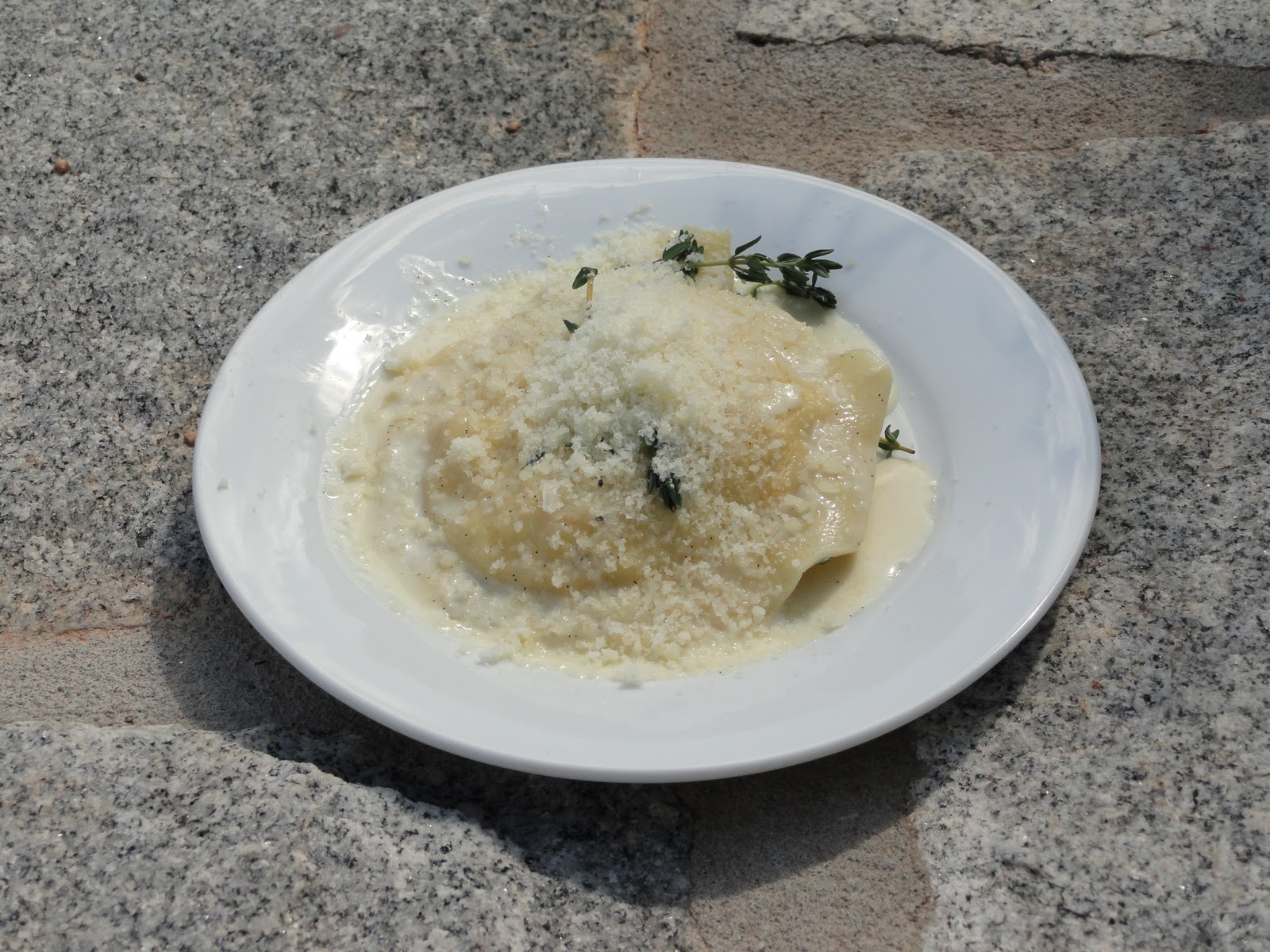
Yellow Corn Ravioli with Vanilla Cream Sauce

Ravioli Dough
2 cups flour
2 whole eggs
1 egg yolk
1 T extra virgin olive oil
1 tsp salt
  1. Combine all ingredients into a mixer. Using the dough hook, mix until it forms a ball.
  2. Knead by hand for 1 minute more. Smooth out the ball, place in fridge and chill for 30 minutes.
  3. Using a pasta machine or rolling pin, roll the dough into a thin sheet.
  4. Cut the sheet in half and set one half to the side.
  5. Place the filling onto the pasta sheet one tablespoon at a time leaving about one inch between each portion of the filling.
  6. Place the remaining pasta sheet on top and press down firmly around filling.
  7. Using a knife or cutter, cut the ravioli apart.
  8. Cook or freeze immediately.
  9. Cook the ravioli in boiling, salted water for 2 - 3 minutes.


Filling
3 T extra virgin olive oil
1 1/2 cups yellow corn kernels
1 medium shallot, diced
1 clove garlic, chopped
1 T fresh thyme leaves
salt and pepper, to taste
1/2 cup mascarpone cheese
  1. In a sauce pan, heat olive oil over medium high heat.
  2. Next add the corn, shallot, garlic and thyme.
  3. Sauté for a few minutes until the corn becomes tender and reduce heat to low.
  4. Season with salt and pepper to taste.
  5. Add the mascarpone cheese and stir until smooth. Taste and adjust the seasoning if needed.
  6. Allow to cool for a few minutes before assembling ravioli. 

Vanilla Cream Sauce
1 T olive oil
2 T shallots, chopped
1/2 cup sweet white wine
2 sprigs fresh thyme
1 vanilla bean
1 cup heavy cream
Salt and pepper, to taste
1/4 cup grated parmesan cheese
2 T unsalted butter
  1. In a pan, heat olive oil and 1 tablespoon of butter over medium heat.
  2. Add the shallots and cook for 1 minute.
  3. Next add the white wine, thyme and vanilla. Cook until wine is reduced by 90 percent.
  4. Add the heavy cream and allow to reduce by half.
  5. Season with salt and pepper.
  6. Finish the sauce by adding the parmesan cheese and remaining butter.
  7. Serve over hot ravioli. 

Vanilla Crepes with Minted Fruit Salad

Vanilla Crepes
1/2 cup milk
1 whole egg
1 egg yolk
Seeds of 1/2 vanilla bean, scraped
2 tsp sugar
2 tsp butter, melted
1/2 cup flour
  1. In a bowl, combine milk, egg, egg yolk, vanilla and sugar. Mix together with a whisk.
  2. Add the flour and stir until smooth.
  3. Stir in the melted butter.
  4. Allow the batter to sit in the refrigerator for at least 15 minutes before using.

To cook crepes, use a good non-stick pan. Over medium high heat, spray the pan with cooking spray or a thin coat of oil or butter. Pour ¼ cup of the batter (adjust as necessary for different pan sizes and desired crepe size) into the center of the pan. Move the pan around to distribute the mixture forming a very thin pancake layer.


Cook for 30 - 45 seconds on one side. Using a rubber spatula, flip and cook the other side. Repeat process.


Minted Fruit Salad
1/2 cup orange segments
1/2 cup blueberries
1/2 cup raspberries
1/2 cup fresh strawberries, diced
3 T fresh mint, chopped
1 T sugar
  1. Combine all of the ingredients into a medium size bowl and toss together gently.
  2. Let mixture sit for 30 minutes.
  3. Serve with Vanilla Crepes.

Thursday, March 10, 2011

Are Tulips Edible?

The spring-like weather in late February produced signs of spring all around the Atlanta Botanical Garden.  The Edible Garden is teeming with daffodils and tulips which raises the question, “are bulbs edible?” We eat garlic and onion bulbs but can you eat flowering spring bulbs?

Daffodils are poisonous to humans and animals, so keep those off your plate.

There are conflicting views on tulips, so I’m not going to recommend that you eat them without further research.  Many people say that you can eat tulip flower petals but caution that some people may have allergic reactions after consuming or even touching them.  During WWII, the Dutch ate tulip bulbs when times were tough.  Sounds like you could eat them if necessary for survival but stay away from plants treated with pesticides or possible fungus on decaying bulbs.  Gardeners know that squirrels find them delectable.  Maybe they’re on to something.

Along with the bulbs, a few other things are waking up in the Edible Garden.

Definitely edible!  The warm weather queued the asparagus to grow in February, usually harvestable in late March through June in Georgia.

The crabapples are budding.

Waves of daffodils welcome visitors to the Edible Garden.  This is a tiny portion of the 200,000 bulbs planted for Atlanta Blooms! 

Tuesday, January 4, 2011

Chocolate Sunday

On the second Sunday of each month during Chocolate: Seed to Sweet, the Garden hosted demonstrations by Atlanta pastry chefs and chocolatiers.  For the final Chocolate Sunday, we welcomed CocoaTown and Chef Cynthia Wong from Cakes & Ale.  CocoaTown demonstrated small scale equipment used to turn cocoa beans into chocolate bars.  Scroll down for photos and a tasty chocolate cupcake recipe.

Chocolate comes from the fruit of the cacao tree (Theobroma cacao).  This particular cacao pod is slowly growing in the Fuqua Conservatory at the Atlanta Botanical Garden.  

The CocoaTown Roaster roasts up to five pounds of fermented cocoa beans. 

Roasted cocoa beans are cracked, resulting in smaller pieces known as nibs.  Other machines involved in the process winnow and grind the nibs into chocolate liquor.  A pressing machine separates the chocolate liquor into cocoa butter and cocoa solids.

Cynthia Wong, Pastry Chef at Cakes & Ale demonstrates Dulce de Leche German Chocolate Cupcakes.

Cynthia Wong’s Chocolate Cupcakes

1 cup all purpose flour
1 1/3 cups Valrhona cocoa powder
¾ tsp baking powder
½ tsp kosher salt
1 ¾ cups granulated sugar
12 oz butter
4 extra large eggs
¾ cups crème fraiche
  1. Preheat oven to 350F.
  2. Sift together flour, cocoa powder, baking powder and salt.
  3. Cream butter and sugar until fluffy and light.
  4. Add eggs one at a time, beat until fluffy.
  5. Fold in half of dry ingredients, then crème fraiche, then rest of dry ingredients.
  6. Scoop into cupcake papers and bake for about 20 minutes, or until the tops spring back lightly when touched.
Makes 2 dozen